You are who you post.
- acox31
- Sep 22, 2021
- 5 min read
Updated: Sep 26, 2021
“Anyone can learn.”
“Learn computer science. Change the world.”
“Learn today, build a brighter tomorrow.”
“Every student in every school should have the opportunity to learn computer science.”
The tag lines that are splashed across the website and social media accounts of Code.org might differ from platform to platform, but what is clear is the education nonprofit’s brand and mission to expand computer science education opportunities to all students in all schools.

Before I’m accused of bias for evaluating the social media presence of the organization I work for, I want to posit that I may be among the best candidates to offer a critique. My proximity to the organization means I know what our target audiences are and what the messaging is supposed to be. Combining these perspectives with a "reading” of Code.org’s three most followed social media accounts (Twitter, Facebook, and YouTube), my goal is to determine whether we have a cohesive brand identity and identify ways our Marketing team might continue to strengthen it.
For each of our top three accounts, I’ll share the current number of followers and any other interesting statistics (I love fun facts!), and offer my general impressions of the visuals and recent content from an objective a standpoint as I can muster.

Follower count: 1M
A casual scroll through the @codeorg Twitter account reveals it to be our most active social media account. Between the re-tweeted photos and videos of cute students working through computer science lessons, fun CS-related factoids, links to our Medium posts (our least followed, and newest SNS), and promotions for events or initiatives we’re hosting, our social media manager adds content to our Twitter feed daily – and even schedules content to be published on the weekends. As almost a rule, our posts contain a visual graphic or video to go alongside the 280 character-limited tweet. The profile image is of our logo, and the banner image contains younger, smiling children who are holding computers to reinforce the impression that we are, in fact, an ed tech organization.
Speaking of impressions... the number of impressions (replies, retweets, and likes) vary from post to post, but overall the feed contains upbeat, short-form content that is accessible to a global audience that skews toward educators, school administrators, and members of the tech industry.

Follower count: 788K
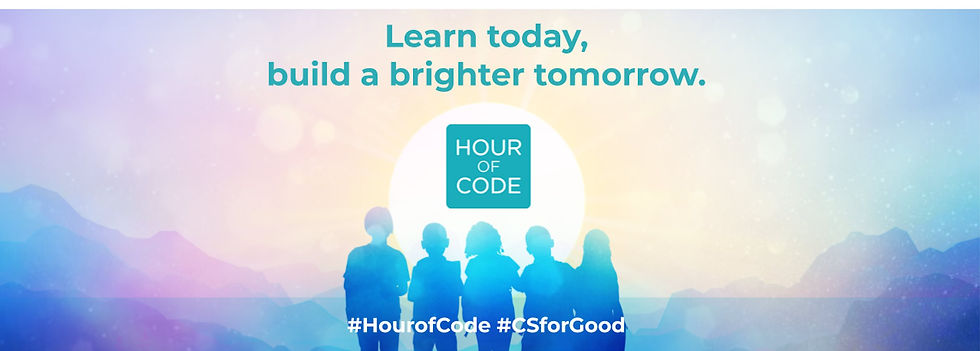
Similar to our Twitter feed, the Code.org Facebook profile is dotted with daily posts that sit more on the longer-form side of the spectrum, including links to CS-related news articles, our own blog posts on Medium, spotlights of role models in CS, and promotions for our upcoming initiatives. As with Twitter, the profile image is our company logo, but the banner is a bright graphic of children silhouetted against a watercolor horizon with the logo for our annual education campaign, the Hour of Code. The tagline, “Learn today, build a brighter tomorrow” heads the top of the image, and the hashtags #HourofCode and #CSforGood are centered at the bottom.
Like our tweets, the number of impressions (reactions, comments, shares) generated by our Facebook posts vary, depending on the content. I can only guess at the demographics of our Facebook followers because they are hidden. Based on hearsay, I know that our Facebook audience is largely based internationally, and primarily consists adults, many of whom are teachers or casual followers of the CS education movement and the ongoings of the tech industry more broadly.

YouTube
Subscriber count: 373K
Our most visual account, and arguably the reason I even have a job in the first place, Code.org’s YouTube channel is our third most followed account and has racked up a cumulative 78.4M views as of the writing of this post. Our organization began with a video our CEO and cofounder, Hadi Partovi, helped produce with his twin brother in 2013: What Most Schools Don’t Teach. That video currently has more than 15M views and is our most viewed video to date.
Along with our origin story video, the Code.org YouTube channel contains a variety of videos that range from instructional (How the Internet Works), to informational (Getting Started – Basic features of Code.org), and from inspirational (Push yourself. Anyone can learn.), to international (Lo Que Falta En Nuestras Escuelas) as our partnerships have expanded over the years to Spanish-speaking countries. The audience for our YouTube channel is global, and it includes students, teachers, parents, policymakers, school administrators, and almost everyone in between. Like Twitter and Facebook, the profile image is that of our logo. The banner image features young girls, presumably students, of color working at computers, which aligns with the mission statement that’s shared in the YouTube channel description: “Code.org® is a nonprofit dedicated to expanding access to computer science in schools and increasing participation by young women and students from other underrepresented groups” (Code.org, n.d.).
Although not all of our 619 posted YouTube videos are unified around a single visual aesthetic, they are united by topic and tone, and most of the instructional videos are embedded in our courses.
So, who are we exactly?
I conclude my survey of Code.org’s social media accounts here for a few reasons: the remaining three (Instagram, LinkedIn, and Medium) have fewer combined followers than our YouTube account, we don’t post daily content to them, and the content they do contain is cross-posted to our more followed platforms.
This leads to the original question: Who is Code.org, according to these social media accounts?
As an organization, we are faceless. While Hadi, our founder, makes the occasional appearance in the photos we post, our identity on these SNSs is less personal and more promotional of computer science education. In terms of the five major impression strategies on social media platforms, it is our content and not our own self-image that ingratiates and exemplifies us with our followers (Kuznekoff, 2013). Despite the negative sound of it, I’d argue that this facelessness, works in our favor because it allows us the flexibility to post across different content types and calls to action all in service of furthering our mission and the broader movement to expand CS education opportunities.
Politically-speaking, Code.org’s identity presents as left-leaning by nature of our connections to the tech industry (historically, liberal), and because many of our channels currently feature a short video of President Biden speaking about Code.org in 2014, when he was serving as Vice President. Despite this, we put in a lot of effort to emphasize in our posts that expanding CS education is a nonpartisan effort. No matter how much we promote content and partnerships on both sides of the proverbial aisle, I think this is one aspect of our identity that we’ll never fully divorce ourselves from.
My overall and slightly biased opinion is that the Code.org identity on SNSs is strongly aligned with our cause. While I think there could be some work to establish a more cohesive aesthetic across our platforms, we have established ourselves as a leading force for CS education. Our social media platforms succeed in communicating that we care deeply about making equitable, high-quality CS education available to all schools and all students.

References
Code.org (n.d.). Description. YouTube. https://www.youtube.com/c/codeorg/about
Kuznekoff, J. M. (2013). Comparing impression management strategies across social media platforms. In C. Cunningham (Ed.), Social networking and impression management: Self-presentation in the digital age [eBook edition]. Lexington Books.


Comments